
Baseline Research
Period poverty in Uganda: What 173 girls told us about missing school
A 173-student assessment at Buyanga Primary School documents how cost, pain, inadequate materials, and stigma affect girls' attendance in rural Uganda.
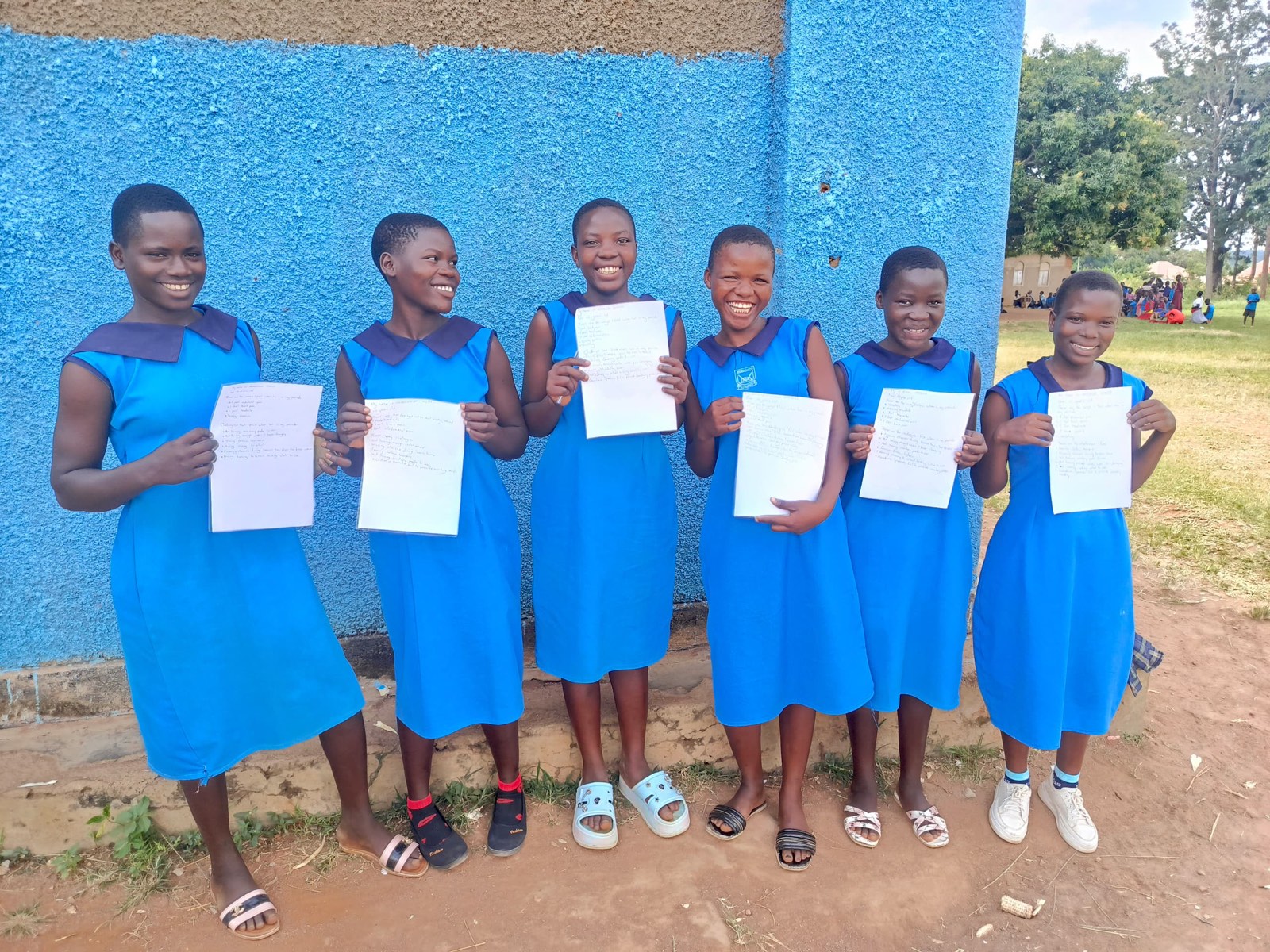
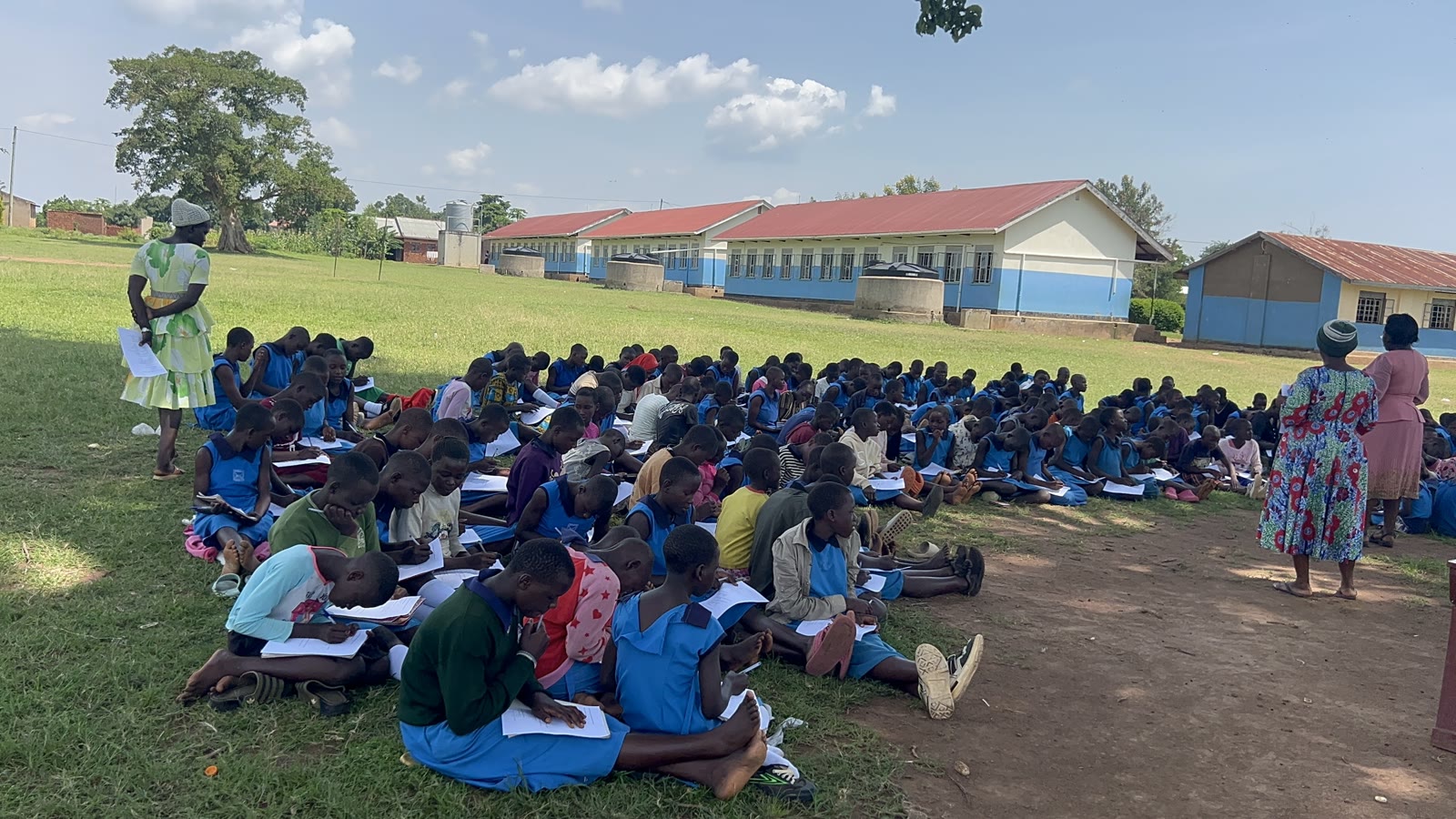
In June 2026, 173 students at Buyanga Primary School sat together on the school grounds and completed a menstrual-health and attendance assessment. They answered questions about pain, materials, cost, safety, concentration, and the school days they miss. Six students also chose to write about the experience in their own words.
A handwritten page is not a statistical instrument. But when six girls describe the same fears in six different hands, and 167 of 168 survey respondents report missing school during their periods, the handwriting and the dataset begin to tell the same story.
The cost of menstruation at Buyanga is measured twice: in materials families cannot afford and in lessons girls do not attend.
The school had raised the need with Global Village Connect. The assessment was conducted to understand that need before designing the Keep Girls in School program, not to justify a solution that had already been chosen.
What 173 students told us
Most menstruation-specific questions received 167 or 168 valid responses. The findings below use the valid responses to each individual question.
| What students reported | Baseline result |
|---|---|
| Miss school during their period at least sometimes | 167 of 168 (99%) |
| Use cloth to manage their period | 158 of 168 (94%) |
| Failed to obtain pads because of cost in the previous three months | 166 of 168 (99%) |
| Usually miss two to three days during a period | 113 of 168 (67%) |
| Have been teased or embarrassed at school because of their period | 123 of 168 (73%) |
| Feel safe and comfortable managing their period at school | 39 of 167 (23%) |
None of the 168 students who answered the question said they always had enough pads or menstrual materials. Nearly every respondent said a lack of pads contributed to absence, while fear of staining a uniform and menstrual pain were also common reasons for missing class.
The effects continue even when a student reaches school. Almost every respondent said menstruation makes concentrating in class difficult at least sometimes, and 166 of 167 said they had left school early because of their period.
At Buyanga, it appears as pain without relief, too little underwear to change safely, fear of a stained uniform, teasing from classmates, leaving school early, and lessons missed month after month.
The written accounts behind the percentages
The survey rows show how often a barrier appears. The handwritten accounts show how several barriers arrive at once.
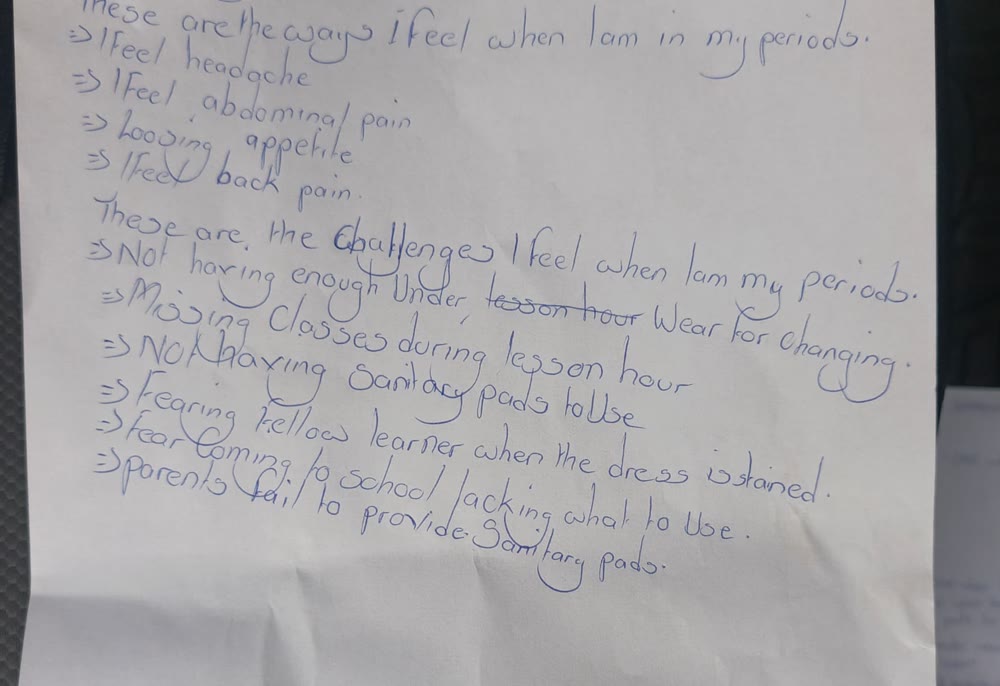
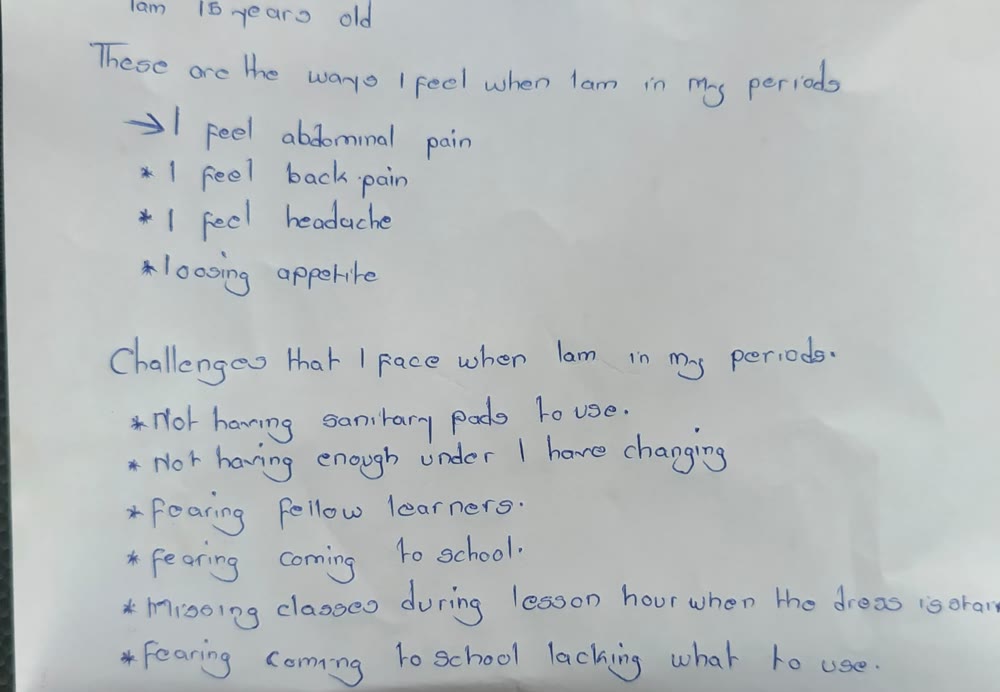
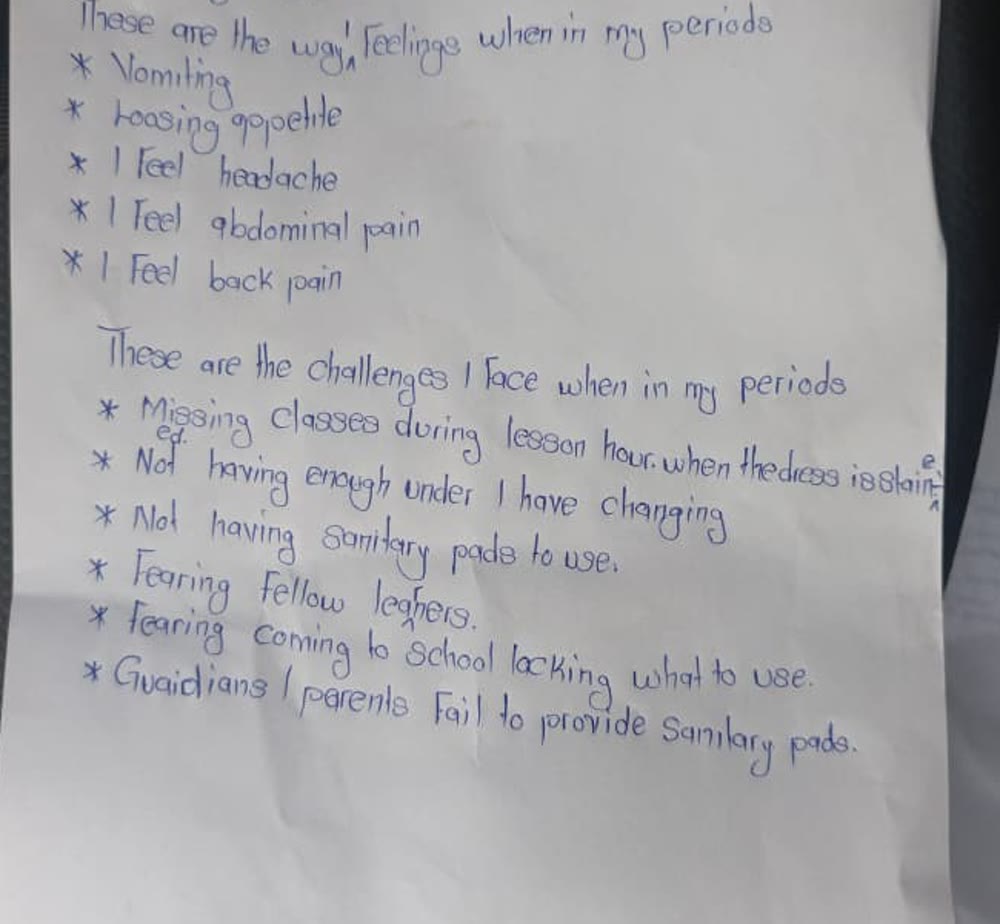
The images above are mechanical crops of the students’ original pages. Identifying headers have been removed; the handwriting has not been generated, rewritten, or visually altered.
“I fear coming to school lacking what to use. My parents fail to provide sanitary pads.”
Shatura N.
“I miss classes during lesson time when my dress is stained. I fear coming to school without what to use.”
Mariam K.
“Not having sanitary pads, not having enough underwear for changing, and fearing fellow learners make me miss classes.”
Dorcus N.
The excerpts are transcribed from the original accounts and lightly edited only for punctuation and clarity. First names and last initials are used with school and family approval.
The girls also told us what would help
The survey did not ask students to choose from a program GVC had already designed. It asked what would help them most.
- 167 of 168 selected free pads.
- 167 of 168 selected extra underwear.
- 147 of 168 selected pain relief.
- 119 of 168 selected menstrual health education.
- 36 of 168 selected someone they could talk to.
The near-unanimous requests for both pads and underwear are important. A product cannot be used safely or confidently without something clean to hold it in place. Pain relief, accurate information, and a trusted adult address different barriers that a pad alone cannot solve.
What absence looks like over a school year
The school’s attendance-register baseline records an average of 2.2 days missed per girl per menstrual cycle. At that rate, period-related absence can approach 20 school days over a year.
The survey supports what the register shows: 113 students said they usually miss two to three days, 46 reported one day, and nine reported more than three days during a period.
For a student already working to keep pace with lessons and exams, repeated absence is cumulative. One missed lesson becomes unfinished work; unfinished work becomes a learning gap; and that gap can eventually affect progression and completion.
This matters within a national education system where staying in school is already difficult. A 2024 mapping report from Uganda’s Ministry of Education and Sports, the European Union, and UNICEF found that only slightly more than one in four children attend secondary school, while 69% of adolescent girls have never attended secondary school. Financial barriers remain the main reason children do not attend or leave school. UNICEF also reports that education costs account for six in ten people leaving school in Uganda.
Menstruation is not the only reason a girl may miss school. But for students already navigating school fees, household poverty, distance, safety, and care responsibilities, a recurring barrier can compound the risk of falling behind.
What Ugandan research shows
The Buyanga assessment is a school baseline, not a national prevalence study. Its value is local specificity: it shows what is happening among the students this program is designed to serve. Published Ugandan research helps place those findings in context.
A 2018 study in four secondary schools in Entebbe found that menstrual pain, inadequate materials, embarrassment, and fear of teasing were connected to absence. In a 40-girl diary substudy, absence was reported on 28% of period days compared with 7% of non-period days. The authors argued that school responses need to address physical conditions, including pain, materials, and water and sanitation, together with psychosocial conditions such as confidence, attitudes, and stigma.
More recent evidence reinforces that menstruation is not a single-product problem. A 2026 prospective analysis of students in 60 Ugandan secondary schools found that inadequate materials, unmet menstrual-practice needs, negative attitudes, and menstrual teasing were associated with absence and poorer examination performance. Pain was also associated with menstrual-related absence.
Uganda has responded at the policy level. In 2026, the government launched Menstrual Health Guidelines for Schools and Education Institutions, framing menstrual health as a matter of dignity, confidence, and uninterrupted education.
A rigorous 2025 trial across 60 Ugandan secondary schools found that a comprehensive intervention improved menstrual knowledge, attitudes, pain management, self-efficacy, and other menstrual-health outcomes. It did not show improved attendance, mental health, or educational performance after one year. That result does not make menstrual support unimportant; it shows why GVC must measure attendance rather than assume it will change.
The trial’s conclusion was appropriately cautious: improving menstrual health is important for health and human rights, but was not sufficient by itself to improve educational performance over one year. Buyanga is a different setting and age group, with a different baseline. GVC’s pilot cannot borrow another program’s success or failure. It has to publish its own result.
How the evidence shaped the Buyanga pilot
GVC designed the pilot around what students and the school identified, rather than treating pads as the only need. A $25 gift is designed to support one girl for a full year, including:
- age-appropriate menstrual products, including reusable kits for older students and disposable products where appropriate
- two pairs of underwear
- period pain relief and supplies for the school sick bay
- menstrual health education and access to a trusted adult
- distribution, follow-up, attendance monitoring, and replacement support
The initial program will operate at Buyanga Primary School. The purpose of the pilot is both to remove an immediate barrier and to test whether a complete, school-based response produces measurable improvements in attendance and safety.
How we will know whether it worked
GVC will digitize the attendance register monthly and repeat the same questionnaire at the end of the first year. Results will be published even if the program does not reach every target.
| Indicator | June 2026 baseline | Year 1 target |
|---|---|---|
| Girls missing school during their period | 99% | Below 25% |
| Days missed per girl per cycle | 2.2 days | Below 0.5 day |
| Girls using improvised cloth | 94% | Below 10% |
| Girls unable to afford pads in the previous three months | 99% | Below 5% |
| Girls who feel safe managing their period at school | 23% | Above 70% |
| Reusable kits still in good condition after six months | New measure | Above 85% |
The school attendance register is the primary outcome measure because it is maintained by teachers independently of the students’ survey responses. The endline questionnaire will help explain why attendance changed, or why it did not.
These are program targets, not forecasts. The primary question is not whether supplies were distributed. It is whether students attended more school, felt safer managing menstruation there, and could maintain the materials they received.
Help start the Buyanga pilot
The assessment documented a preventable barrier affecting nearly every student who responded. The next step is to fund the supplies, support, and measurement needed to address it.
$25 can support one girl for one year through the Keep Girls in School campaign.
Methodology note
The baseline assessment was conducted at Buyanga Primary School in June 2026 with 173 participants in Primary 3 through Primary 7. Ages reported ranged from 12 to 17. Menstruation-specific questions generally received 168 valid responses; one question received 167. Percentages are rounded to the nearest whole number and use the valid responses to each question as the denominator.
Survey findings are self-reported and describe this participating group at Buyanga; they should not be read as prevalence estimates for Uganda as a whole. The 2.2-day attendance baseline comes from the school’s attendance register and is tracked separately from the questionnaire. GVC has school and family approval to use the assessment data and student accounts. Published images remove identifying headers, and students are identified in text by first name and last initial only.
Sources and further reading
- Ministry of Education and Sports, European Union, and UNICEF: Mapping cash-plus programmes for education outcomes in Uganda (2024)
- UNICEF Uganda: Education situation and barriers
- Miiro et al.: Menstrual health and school absenteeism among adolescent girls in Uganda (2018)
- Nalugya et al.: Process evaluation of a comprehensive menstrual-health intervention in Ugandan schools (2020)
- Nelson et al.: MENISCUS cluster-randomized controlled trial in 60 Ugandan secondary schools (2025)
- Baleke et al.: Menstrual health, absenteeism, and examination performance in Uganda (2026)
- UNFPA Uganda: Launch of national menstrual-health guidelines for schools and education institutions (2026)
More Field Notes
Keep reading
When the harvest fails: What 49 Kwania households told us about hunger
A July 2026 GVC assessment in one Kwania District village found crop failure, empty food stores, reduced meals, and urgent requests for a 30-day food bridge.
Bridging the gap between schooling and employment
An honest look at the transition after school for two GVC-supported students, and why academic schooling without vocational options can leave girls behind.